By the BibleInsight Editorial Team Updated June 2026 15 min read
2.6B
Christians Worldwide (2026)
28.8%
Share of World Population
50,000
Denominations (2025)
3B+
Projected by 2050
Definition of the Christian Church
The Christian Church is the universal community of believers who follow Jesus Christ as Lord and Savior, guided by the teachings of the Holy Bible. At its heart, the church is not merely a building or institution; it is the “body of Christ,” a living spiritual community united by shared faith, worship, and the gospel of Jesus Christ.
The word “church” originates from the Greek term ekklesia, meaning “called-out assembly.” This term appears throughout the New Testament to describe those called out of the world into fellowship with God.
This community, therefore, represents a people set apart bound not by ethnicity or geography, but by salvation and faith in Christ.
Theologians recognize two dimensions of the church. The universal church encompasses all believers across time and denomination, while the local church refers to a specific gathered congregation. Both expressions are essential to understanding what this institution truly means in Scripture and in daily life.
| Term | Origin | Meaning |
| Church | Greek: ekklesia | Called-out assembly of believers |
| Christian | Greek: Christianos | Follower of Christ (first used in Antioch, Acts 11:26) |
| Body of Christ | Pauline Epistles (1 Cor. 12:27) | Metaphor for the unified spiritual community of believers |
| Congregation | Latin: congregare | A local gathering of Christians for worship and discipleship |
“And I tell you that you are Peter, and on this rock I will build my church, and the gates of Hades will not overcome it.”
Matthew 16:18 (NIV) Jesus Christ’s foundational declaration of the Christian Church
History of the Christian Church

The history of Christianity begins with the ministry, death, and resurrection of Jesus Christ in first-century Judea. Following the Day of Pentecost when the Holy Spirit descended upon the apostles as described in Acts 2 the early church was formally born in Jerusalem. The disciples of Jesus Christ immediately began proclaiming the gospel, and within days, thousands were added to the faith.
The spread of Christianity across the Roman Empire was rapid despite early persecution under emperors such as Nero and Diocletian. Believers gathered in homes, underground catacombs, and eventually public basilicas. The apostles of Jesus Christ, particularly Paul carried the gospel across Asia Minor, Greece, and Rome, laying the foundation for what would become a global Christian Church.
~33 AD
Day of Pentecost The Holy Spirit descends; the early church is born in Jerusalem with 3,000 baptisms (Acts 2).
~47–67 AD
Apostolic Missions The apostles Paul, Peter, and others spread Christianity across the Roman Empire. The term “Christian” was first used in Antioch.
64–313 AD
Early Christian Persecution Roman emperors persecute the church. Christianity grows underground, forging deep communal bonds.
313 AD
The Edict of Milan Emperor Constantine legalizes Christianity, ending official persecution and opening the faith to public worship.
325 AD
Council of Nicaea The first ecumenical council of this ecumenical gathering, convened by Constantine, addresses the Arian controversy and produces the Nicene Creed, confirming Christ’s divinity.
380 AD
Christianity Becomes State Religion Emperor Theodosius declares Nicene Christianity the official religion of the Roman Empire.
1054 AD
The Christian Church splits into Western (Catholic) and Eastern (Orthodox) branches, marking the most significant division in church history to that date.
1517 AD
Protestant Reformation Martin Luther posts his 95 Theses, igniting the Reformation. Protestant denominations emerge, permanently reshaping the denominational landscape.
1906 AD
Azusa Street Revival The modern Pentecostal movement is born in Los Angeles, launching one of the fastest-growing streams within the Christian Church.
2025 AD
Global Christianity Today Christianity reaches 2.6 billion members across approximately 50,000 denominations worldwide.
The development of Christian theology accelerated through the Patristic era, shaped by Church Fathers like Augustine, Athanasius, and Origen. The role of Christianity in Western civilization is immeasurable; it shaped law, education, art, medicine, and social ethics for centuries. Understanding that history timeline reveals how faith and institution evolved side by side through triumph and trial.
Core Beliefs of the Christian Church
The church, across its many expressions, holds a set of foundational doctrines derived from Holy Bible teachings. These beliefs form the backbone of Christian faith, giving identity and purpose to every congregation regardless of tradition or geography. Doctrine and beliefs center on the nature of God, humanity, salvation, and eternity.
Central to Christian faith beliefs is the doctrine of the Trinity that God exists as Father, Son, and Holy Spirit, three persons in one divine nature. This was formally affirmed at the Council of Nicaea in 325 AD. The resurrection of Jesus’ meaning is equally vital: Christians believe Christ rose physically from the dead on the third day, defeating sin and death, and opening the way to salvation in Christianity for all who believe.
| Core Doctrine | Biblical Basis | Summary |
| The Trinity | Matthew 28:19; 2 Cor. 13:14 | One God in three persons: Father, Son, and Holy Spirit |
| The Incarnation | John 1:14; Luke 1:35 | Jesus Christ is fully God and fully man |
| Salvation by Grace | Ephesians 2:8–9; Romans 3:23–24 | Salvation is God’s gift through faith in Christ, not earned by works |
| Resurrection of Christ | 1 Corinthians 15:3–4; Luke 24 | Jesus rose from the dead, confirming his divinity and securing eternal life |
| Authority of Scripture | 2 Timothy 3:16–17; Psalm 119:105 | The Bible is God’s inspired, authoritative Word for faith and life |
| The Great Commission | Matthew 28:18–20; Mark 16:15 | This community is called to spread the gospel to all nations |
The sacraments in Christianity practices such as Baptism and the Lord’s Supper (Communion) are recognized across nearly all Christian traditions, though their theological interpretation varies. Christian worship practices likewise differ in style yet converge on adoration of God through prayer, music, preaching of the gospel of Jesus Christ, and fellowship among believers.
- Faith in Jesus Christ Believing in the life, death, and resurrection of Jesus as the only path to salvation
- The Holy Spirit in Christianity The third person of the Trinity, active in the life of every believer and the church
- Baptism The public declaration of faith and initiation into the Christian community
- Prayer and Scripture Ongoing communication with God and daily engagement with Bible-based teachings
- Love of Neighbor The second greatest commandment: to love others as God loves us (Matthew 22:39)
- Hope in Eternal Life The belief that physical death is not the end; believers will be resurrected to eternal life with God
Also Read: 13 Prayers for My Daughter Success
Role of the Christian Church in Modern Society
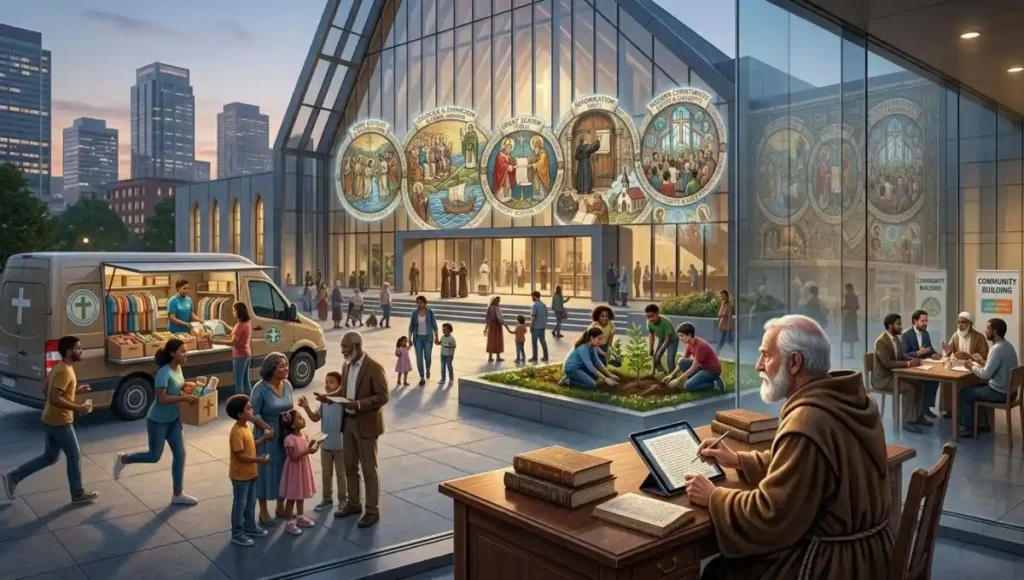
The Christian Church remains one of the most influential forces in contemporary global society. Far from declining, global Christianity population figures show that Christianity is growing faster than the world population itself with 2.6 billion members in 2025 and a projected 3 billion by 2050, according to the Center for the Study of Global Christianity at Gordon-Conwell Theological Seminary.
In areas like healthcare, education, and humanitarian aid, it operates some of the world’s largest non-governmental networks. Christian spiritual communities run hospitals, orphanages, universities, and food banks on every continent.
The church hierarchy structure varies by denomination, but the shared mission of compassion and service remains constant across the global faith community.
The Christian Church by the Numbers (2025)
Catholics: ~1.3 billion the largest single body within Christianity worldwide.
Protestants: Over 625 million and growing at 1.63% annually.
Pentecostal/Charismatics: 663+ million, the fastest-growing Christian movement globally.
Africa’s Christian community: 734 million, growing at 2.64% per year the continent’s transformation is the defining story of 21st-century Christianity.
Source: Center for the Study of Global Christianity, Gordon-Conwell Theological Seminary (2025)
Worship and fellowship in church continue to provide community anchors in increasingly fragmented societies. The church addresses mental health, social justice, poverty, and family life with a theological framework rooted in human dignity. In Africa, South Asia, and Latin America, Christianity is experiencing extraordinary growth, reshaping the cultural identity of entire nations.
The church also engages with technology, media, and modern science. Churches broadcast sermons globally, support online faith communities, and engage in ethical debates around artificial intelligence, bioethics, and environmental stewardship. The faith in the 21st century is neither static nor irrelevant; it is actively shaping the moral conversation of our time.
Types of Christian Churches
The Christian Church today encompasses an extraordinary diversity of traditions, each rooted in a distinct theological heritage. Understanding the types of Christian churches helps believers appreciate the richness of the faith while recognizing the shared gospel that unites them all. Below is an overview of the five major expressions of global Christianity worldwide.
| Tradition | Estimated Members | Founded / Origin | Key Feature |
| Catholic Church | ~1.3 billion | Apostolic 1st century AD | Papal authority, apostolic succession |
| Protestant Churches | ~625 million+ | Protestant Reformation, 1517 | Scripture alone, salvation by faith |
| Eastern Orthodox Church | ~260 million | Great Schism, 1054 AD | Conciliar governance, ancient liturgy |
| Evangelical Churches | ~420 million+ | 18th–19th century revivals | Born-again experience, biblical authority |
| Pentecostal Churches | ~663 million+ | Azusa Street Revival, 1906 | Gifts of the Holy Spirit, expressive worship |
1. Catholic Church
Catholic Tradition
The Catholic Church is the largest denomination within Christianity, with approximately 1.3 billion baptized members worldwide. It traces its origins through apostolic succession, the unbroken chain of ordained authority from the apostles of Jesus Christ to the present Pope. Catholic Church beliefs and traditions center on the seven sacraments, the authority of Scripture and Sacred Tradition, and the universal leadership of the Bishop of Rome.
The Catholic Church played the defining role in shaping Christianity throughout the first millennium. Western and Eastern Christianity differences that eventually led to the Great Schism of 1054 were already forming in disputes over the Pope’s supreme authority, the filioque clause, and liturgical practices. Today it remains headquartered in Vatican City and operates the world’s largest non-governmental healthcare and education network.
2. Protestant Churches
Protestant Tradition
Protestant churches emerged from the 16th-century Protestant Reformation, sparked by Martin Luther’s 95 Theses in 1517. The core Protestant conviction sola scriptura (Scripture alone) and sola fide (faith alone) challenged Catholic Church doctrines on indulgences, priesthood, and salvation. Lutheran vs Calvinist beliefs represent the two earliest streams, with Luther emphasizing grace and Calvin stressing divine sovereignty.
The Protestant denominations list today is vast. Anglican Church origins lie in the English Reformation under Henry VIII, while Baptist church teachings champion believer’s baptism and congregational independence. Methodist, Presbyterian, Lutheran, and Reformed churches collectively form a major branch of global Christianity, now numbering over 625 million members. Protestant Reformation’s impact on Western civilization reshaped literacy, democracy, and individual conscience.
3. Eastern Orthodox Church
Orthodox Tradition
Eastern Orthodox Church history begins with the formal split of the church in the Great Schism of 1054, separating Eastern and Western Christianity after centuries of growing theological and political tension. Centered in Constantinople (modern Istanbul), the Orthodox church is governed by a council of Patriarchs rather than a single pope, a system reflecting its deep commitment to conciliar authority.
Eastern Orthodox Church history is rich with mystical theology, iconography, and ancient liturgical worship tracing directly to early apostolic practices. Today, with approximately 260 million members, the Orthodox Christian Church is strongest in Russia, Greece, Eastern Europe, and the Middle East. Its theology emphasizes theosis of the believer’s gradual transformation into the likeness of God as the goal of Christian spiritual life.
4. Evangelical Churches
Evangelical Tradition
Evangelical Christianity beliefs center on the necessity of personal conversion, the absolute authority of the Bible, and the urgent mission to spread the gospel of Jesus Christ. The term “evangelical” derives from the Greek euangelion meaning “good news” and represents those within the Christian Church who place the proclamation of Christ’s saving work at the center of all ministry.
Evangelicalism cuts across denominations, encompassing Baptist, Methodist, Presbyterian, and independent churches. With over 420 million adherents, Evangelical Christianity is growing at 1.66% annually. It is especially dynamic in sub-Saharan Africa, South Korea, Brazil, and the United States, where Evangelical churches lead in church planting, missionary activity, and youth ministry within global Christianity.
5. Pentecostal Churches
Pentecostal church practices are rooted in the belief that the supernatural gifts of the Holy Spirit including speaking in tongues, divine healing, and prophecy remain active in the church today, just as on the original Day of Pentecost (Acts 2). This movement ignited at the Azusa Street Revival in Los Angeles in 1906 and spread with remarkable speed across the globe.
Today, the Pentecostal and Charismatic stream of the Christian Church numbers over 663 million and is growing at 1.48% annually making it one of the fastest-growing segments of global Christianity. Pentecostal worship is expressive, prayer-centered, and deeply communal. From Nigeria’s megachurches to Brazil’s Assembly of God to South Korea’s Yoido Full Gospel Church, Pentecostal churches are reshaping what Christianity looks like in the 21st century.
Conclusion
The Christian Church stands as the most far-reaching spiritual community in human history born in a Jerusalem upper room, forged through persecution, shaped by councils and reformers, and now spanning every nation on earth with 2.6 billion members. It is at once ancient and alive, divided yet united by the person of Jesus Christ and the gospel contained in the Holy Bible.
From the Catholic Church’s ancient sacramental tradition to the Pentecostal Church’s vibrant Spirit-led worship, from the Orthodox Church’s mystical liturgy to the Evangelical Church’s missionary zeal, it is not a monolith, it is a mosaic. Each tradition carries a unique expression of the same saving faith.
What remains constant across every tradition is the centrality of Christ: his teachings, his sacrifice, his resurrection, and his promise to return. Understanding the Christian Church, its definition, its history, and its diversity is ultimately an invitation to understand the gospel itself. And that gospel, as 2,000 years of church history demonstrate, continues to change lives and transform communities around the world.

Welcome to BibleAuraz! I’m Abdul Mannan Haider — Christian Faith Writer | 10+ Years Bible Study Experience | Founder of (BibleAuraz.com) Sharing Bible verses, spiritual meanings, prayers, and biblical wisdom to strengthen your faith and inspire your daily walk with God.