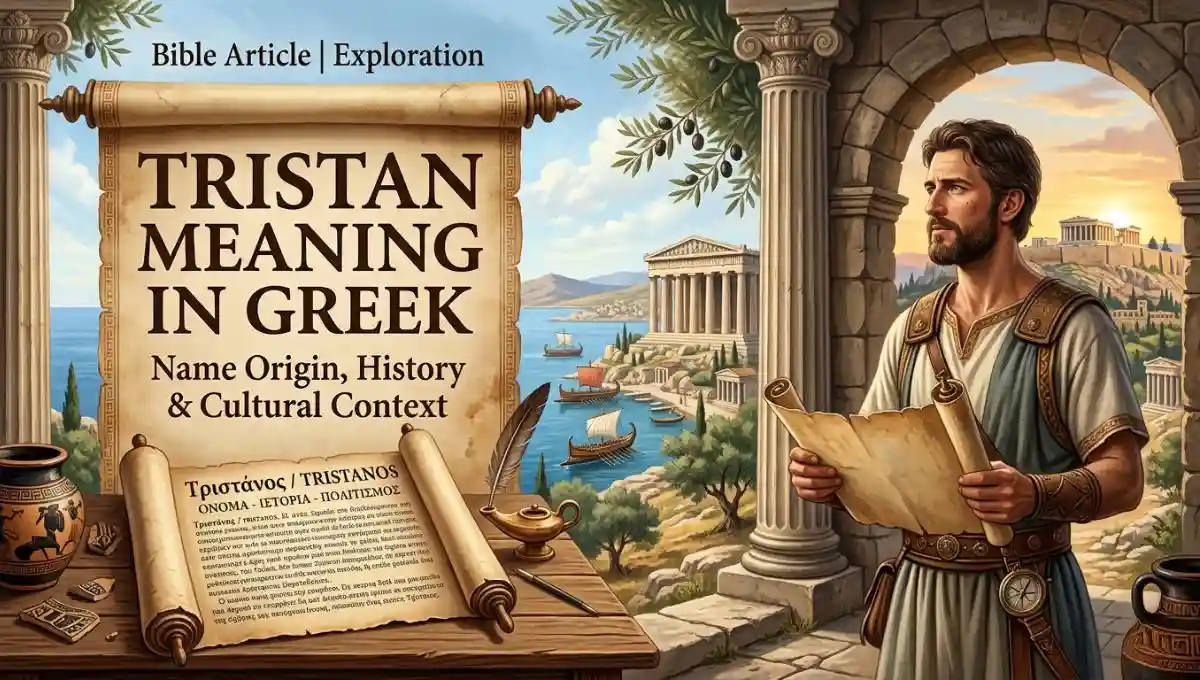
When people search for Tristan mean in Greek, they uncover a name layered with centuries of history, emotion, and cross-cultural resonance. Though Tristan does not hold a direct Greek root, its journey from ancient Celtic tribes through medieval French romance into modern Greek-speaking communities tells a story as compelling as the hero who first bore the name. Understanding what Tristan means reveals far more than a dictionary definition; it opens a window into how names travel across languages, carry emotional weight, and connect us to timeless human experience.
What Does Tristan Mean in Greek?
The Tristan meaning in Greek is not rooted in the Greek language itself. Rather, the name arrived in Greek-speaking cultures through medieval literary exchange and European cross-cultural adoption. When Greek speakers use the name today, they transliterate it as Τρίσταν and pronounce it TREE-stahn, following natural Greek phonetic patterns.
To fully understand what Tristan means from a Greek perspective, one must trace the name back through Latin and then to its original Celtic source, a journey that reveals an emotionally rich identity.
The Greek Etymology of Tristan
Tristan has no confirmed ancient Greek word at its root. The name derives from the Celtic form Drystan or Drustan, meaning “tumult” or “noise.” As the name spread across medieval Europe, scholars connected it to the Latin word tristis, meaning “sad” or “sorrowful.” That Latin root shares deep ancestry with Greek emotional vocabulary particularly the Greek concepts of penthos (grief) and lype (sorrow). So while Tristan mean did not originate in Greek, it was filtered through a Greek-influenced Latin lens that permanently shaped its emotional identity.
The Historical Origin of the Name Tristan

The Tristan name originates in ancient Celtic tribal communities of Britain and Brittany. The earliest documented form is Drustan or Drystan, a Pictish or Brythonic name believed to mean “tumult” or “riot.” The name Tristan evolved from the Celtic name Drustanus, composed of two elements: drust (sadness/tumult) and a suffix suggesting fierceness, giving the full name a dual character emotional depth paired with warrior strength.
The name gained widespread recognition through the medieval legend of Tristan and Isolde, one of the great tragic love stories of Western literature. French storytellers later reinforced the sorrowful association by connecting it to the French word triste, meaning sad, which perfectly mirrored the hero’s tragic fate.
| Origin Layer | Language | Meaning |
| Oldest Root | Celtic (Pictish/Brythonic) | “Tumult” / “Noise” |
| Early Evolution | Welsh / Cornish / Breton | “Bold” / “Sad” |
| Medieval Influence | Old French (triste) | “Sorrowful” / “Melancholy” |
| Greek Adoption | Transliterated Greek (Τρίσταν) | Borrowed international name |
| Latin Connection | tristis | “Full of grief” |
Tristan in Greek Mythology and Ancient Stories
Tristan does not appear in Greek mythology or ancient Greek literature. No classical Greek text, mythological canon, or historical record contains a character named Tristan. The name simply did not exist in ancient Greece because it originated centuries later in Celtic and medieval European regions.
However, the themes that surround the Tristan legend share remarkable resonance with Greek tragic tradition. The story of Tristan and Isolde forbidden love, loyalty, fate, and death echoes the emotional structures of Greek tragedies by Euripides and Sophocles. Greek readers who encountered the legend through medieval translations recognized in Tristan the same moral complexity and tragic heroism that defined their own classical heroes such as Achilles and Orpheus.
This thematic overlap explains why the name, though foreign, felt culturally natural to educated Greek audiences when they first encountered it through Byzantine literary exchanges.
Must Read : Jessica Name Meaning in the Bible
Cultural Significance of Tristan mean in Greek History
How Ancient Greeks Used the Name
Ancient Greeks never used Tristan as a traditional name. Their naming conventions drew from Greek gods, virtues, and mythology names like Alexandros (“defender of men”) or Theodoros (“gift of God”). Tristan had no place in this framework.
The name entered Greek cultural consciousness through two historical pathways:
- Byzantine literary exchange: As medieval romantic literature spread through Europe, Greek scholars encountered the Tristan legend through Latin translations and Byzantine cultural networks.
- Crusader contact: Interactions between Greek territories and Western European Crusaders during the medieval period introduced new naming traditions, including Western romantic names like Tristan.
Aristocratic and educated Greek families were the first to recognize Tristan, viewing it as a marker of cosmopolitan sophistication and European literary awareness.
The Connection Between Tristan and Greek Language
The name Tristan mean connects to Greek language not through direct etymology but through shared emotional vocabulary. The Latin root tristis evolved from the same Indo-European linguistic family that shaped Greek words for grief and sorrow. When medieval Greek scholars encountered the name, its emotional resonance was immediately intuitive: a name about sorrow and depth felt naturally aligned with Greek literary sensibility.
Greek speakers adapted the name through phonetic transliteration: the consonants and vowels mapped cleanly onto the Greek alphabet, producing Τρίσταν. This ease of transliteration helped the name feel integrated rather than awkwardly foreign, contributing to its gradual adoption in Greek-speaking communities.
Tristan vs. Greek Names: Similarities and Differences
Understanding Tristan name origin means recognizing how it differs structurally from native Greek names while sharing certain emotional qualities.
| Feature | Tristan | Greek Names (e.g., Alexandros, Theodoros) |
| Language Root | Celtic / Old French | Ancient Greek |
| Meaning Type | Emotional (sorrow, tumult) | Virtue-based, divine, or nature-based |
| Mythology Link | Medieval European legend | Greek mythology (gods, heroes) |
| Alphabet Form | Τρίσταν (transliterated) | Native Greek script |
| Religious Association | None direct | Often Orthodox Christian saints |
| Popularity in Greece | Rare / cosmopolitan | Very common |
Greek names typically carry meanings tied to virtues, gods, or nature Alexander means “defender of men,” Sophia means “wisdom.” Tristan stands apart because its meaning is rooted in raw emotion rather than idealized virtue, which makes it distinctive even within international naming traditions.
Modern Usage of Tristan in Greek-Speaking Countries
Tristan remains uncommon in Greece today. Greek parents overwhelmingly favor names that reflect Orthodox Christian heritage and classical tradition names like Giorgos, Konstantinos, Maria, and Eleni dominate birth registries. Tristan’s name popularity in Greece is limited to families who value international appeal, European cultural connections, or admire the romantic literary heritage the name carries.
When modern Greeks do use Tristan, it is typically written as Τρίσταν and pronounced TREE-stahn. Families choosing the name often do so for its:
- Cross-cultural recognition across Europe
- Literary and romantic associations
- Distinctive sound that stands apart from traditional Greek names
- Connection to Western European cultural heritage
Biblical and Spiritual Meaning of Tristan
The Tristan meaning in the Bible is indirect but spiritually significant. The name does not appear anywhere in Scripture, not in the Old Testament, New Testament, or apocryphal writings. This is expected: Tristan originated from Celtic and French medieval culture, centuries after the biblical canon was completed.
However, the absence of Tristan from Scripture does not diminish its spiritual value. Many names widely used in Christian families Christopher, Stephanie, Madison also have no direct biblical mention. What matters is whether the name’s meaning and themes align with biblical truth.
The Tristan biblical meaning connects powerfully through its emotional core:
- Sorrow as a path to growth The Bible consistently presents sorrow as a doorway to faith. Job endured profound loss yet remained faithful. David poured raw grief into the Psalms. Jesus wept at Lazarus’s tomb (John 11:35).
- Christ as “Man of Sorrows” Isaiah 53:3 describes Jesus as “a man of sorrows, acquainted with grief,” making the emotional root of Tristan mean deeply resonant with the character of Christ.
- Redemption through trials Romans 5:3–4 teaches that “tribulation produces perseverance, and perseverance character, and character hope,” perfectly mirroring the spiritual arc that Tristan mean suggests.
Key Bible verses that spiritually align with the Tristan name meaning in Bible:
| Bible Verse | Spiritual Connection to Tristan |
| Psalm 34:18 | “The Lord is close to the brokenhearted” |
| Romans 5:3–4 | Suffering builds perseverance and hope |
| John 16:20 | “Your sorrow will turn to joy” |
| Isaiah 53:3 | Christ, a man of sorrows |
| James 1:2–4 | Trials produce maturity and completeness |
| Psalm 30:5 | “Weeping may endure for a night, but joy comes in the morning” |
Personality Traits and Spiritual Symbolism Associated with Tristan
People named Tristan are widely associated with a compelling set of character qualities that emerge naturally from the name’s layered meaning. The Tristan spiritual meaning points to someone shaped by inner experience rather than outward achievement.
Common personality traits linked to Tristan:
- Deep emotional intelligence and sensitivity
- Loyalty that endures through difficulty
- Creative and artistic inclination
- Quiet but resilient inner strength
- Empathy toward the pain of others
- Courage in the face of adversity
Spiritually, Tristan symbolizes the believer who walks through seasons of sorrow without losing faith. Like Job, David, Joseph, and Paul biblical figures who each experienced profound hardship before fulfillment Tristan personality traits reflect someone whose depth of character is forged in trial. The name carries a message: pain is not the final chapter but the fertile ground from which strength grows.
Why Parents Choose Tristan: Greek Heritage Perspective
From a Greek heritage perspective, parents who choose Tristan are typically expressing a cosmopolitan worldview that honors both European tradition and timeless emotional depth. Greek baby boy names with deep historical significance remain popular, and while Tristan is not a native Greek name, it fits the Greek appreciation for names that carry weight and history.
Parents drawn to the name Tristan mean often value:
- Literary heritage The Tristan and Isolde legend spans twelve centuries of retelling across cultures
- Emotional resonance The name speaks to the full spectrum of human experience, not just triumph
- International recognition Tristan is recognized across Belgium, France, Iceland, Spain, Netherlands, Poland, and English-speaking countries
- Timeless masculinity The name carries chivalric and romantic associations without feeling fragile or dated
For Greek families specifically, choosing Tristan often signals an appreciation for pan-European cultural identity connecting Greek heritage to the broader tapestry of Western civilization.
Famous People Named Tristan with Greek Heritage
Several notable people named Tristan have contributed to culture, arts, and public life, reinforcing the name’s associations with creativity, courage, and endurance.
| Famous Tristan | Field | Notable For |
| Tristan Thompson | NBA Basketball | Professional athlete, widely recognized |
| Tristan Tzara | Poetry / Art | Founder of Dada avant-garde movement |
| Tristan da Cunha | Exploration | Portuguese explorer; South Atlantic island named after him |
| Tristan (Brad Pitt character) | Cinema | Legends of the Fall (1994), boosted name popularity significantly |
| Flora Tristan | Literature / Activism | French-Peruvian socialist writer and activist (1803–1844) |
| Tristan l’Hermite | Military / Politics | Influential French political figure, late Middle Ages |
The 1994 film Legends of the Fall, in which Brad Pitt played Tristan Ludlow, brought the name into mainstream American consciousness and contributed to a significant rise in usage during the mid-1990s and early 2000s.
Tristan Name Variations Across Greek Regions
The Tristan name has adapted across different linguistic and regional traditions, producing several recognized variations. In Greek regions, the name is used in its transliterated form, but across Europe and historically connected cultures, the following variants exist:
| Variation | Region / Language | Notes |
| Tristan | English / French | Most common modern spelling |
| Tristam / Tristram | English (medieval) | Found in Arthurian texts |
| Trystan | Welsh | Closest to the original Celtic form |
| Drystan / Drustan | Old Celtic / Pictish | Earliest historical form |
| Tristen / Tristin | Modern English | Alternative American spellings |
| Τρίσταν | Greek | Greek alphabet transliteration |
| Tristão | Portuguese | Variation used in Portugal and Brazil |
In Greek-speaking regions specifically, pronunciation varies slightly by area. In standard Modern Greek, the stress falls on the first syllable: TREE-stahn. In some regional dialects, speakers may shift the emphasis slightly toward the second syllable, but the standard pronunciation follows strict first-syllable accentuation rules consistent with Greek phonetic patterns.
The Symbolism Behind Tristan in Greek Culture
While Tristan mean carries no indigenous Greek symbolism, its adoption into Greek culture brought with it a set of symbolic associations that resonated with Greek literary and philosophical values.
In Greek cultural interpretation, Tristan came to symbolize:
- Tragic love Echoing the Greek understanding that the deepest loves carry the greatest pain
- Heroic endurance The quality of pressing forward despite impossible circumstances
- Emotional honesty A willingness to feel and express sorrow without shame
- Romantic loyalty Fidelity that transcends political and social obstacles
These symbolic dimensions explain why the Tristan and Isolde story found a receptive audience when Greek translators introduced it to Byzantine literary circles. The story’s emotional architecture felt familiar: a hero destroyed not by cowardice but by the overwhelming intensity of love and fate.
How to Pronounce Tristan in Greek
Tristan pronunciation in Greek follows clear and consistent rules. The name is written as Τρίσταν in Greek script, and the pronunciation proceeds as follows:
- Τ (T) Hard “T” sound, as in “top”
- ρ (r) Rolled “r,” slightly trilled
- ί (ee) Long “ee” vowel sound
- σ (s) Soft “s” sound
- τ (t) Second hard “T”
- α (a) Short “ah” sound
- ν (n) Final “n”
Full pronunciation: TREE-stahn (stress on the first syllable)
This differs slightly from the English pronunciation (TRIS-tan), where the first vowel is a short “ih” rather than the Greek long “ee.” Greek speakers find the name phonetically comfortable because it contains only sounds present in the Greek language, requiring no unusual adaptations.
Is Tristan a Popular Name in Greece Today?
Tristan’s name popularity in Greece remains low by traditional standards. Greek naming culture is strongly influenced by the Greek Orthodox Church, which encourages parents to name children after saints whose feast days mark important calendar celebrations. This tradition produces strong preference for names like Giorgos, Nikolaos, Maria, Dimitris, and Eleni.
Tristan is occasionally chosen by:
- Families with international backgrounds or mixed European heritage
- Parents who prioritize distinctive names with pan-European recognition
- Families influenced by Western media, literature, or cinema
In the United States, by comparison, Tristan has shown stronger adoption. According to available name data, Tristan currently ranks approximately #309 among boy names and was a top-100 name in the late 1990s and early 2000s. In Greece, no equivalent ranking exists, as the name remains too rare to track in national statistics.
Tristan’s Role in Greek Literature and Poetry
Tristan does not appear in ancient Greek literature, but the name entered Greek literary consciousness through Byzantine and post-Byzantine translations of medieval European romance. Greek poets and scholars who encountered the Tristan and Isolde legend recognized its alignment with their own literary tradition of exploring eros (passionate love), moira (fate), and pathos (suffering).
Romantic poetry across the broader European tradition which Greek poets of the 19th and 20th centuries engaged with deeply frequently referenced the Tristan legend as a touchstone for tragic love. The name consequently carries poetic resonance even for Greek readers who might never choose it as a given name.
In modern Greek fiction and drama, Tristan occasionally appears as a character name chosen to signal European sophistication or classical romantic heritage, reinforcing its association with literary inspired names that carry cultural weight beyond their immediate meaning.
The Greek Influence on Tristan’s Meaning Over Time
The evolution of what Tristan means has been shaped at multiple points by Greek linguistic and philosophical influence, even if indirectly. The process worked as follows:
- The original Celtic name Drustan carried a meaning of noise and tumult.
- As the name spread through medieval Europe, Latin scholars connected it to tristis (sad/sorrowful).
- The Latin word tristis itself evolved from Indo-European roots shared with Greek emotional vocabulary penthos (grief), lype (sorrow), and algos (pain).
- Byzantine scholars who translated the Tristan legend reinforced these emotional interpretations through a Greek philosophical lens, emphasizing the name’s alignment with themes of pathos and tragic love.
- In modern usage, the Greek transliteration Τρίσταν preserves all original phonetic character while integrating the name fully into the Greek linguistic framework.
The result is a name that carries Celtic origins, Latin emotional depth, and Greek philosophical resonance making Tristan meaning in Greek a genuinely layered subject that rewards careful exploration.
Frequently Asked Questions
Is Tristan a Biblical Name?
No. Tristan does not appear anywhere in the Bible, not in the Old Testament, New Testament, or apocryphal texts. It is of Celtic and French origin. However, its core meaning of sorrow aligns powerfully with biblical themes of trials, faith, and redemption found throughout Scripture.
What Nationality Is the Name Tristan?
Tristan originates from Celtic (Pictish/Brythonic) Britain and Brittany, later shaped by Old French linguistic influence. It is primarily associated with Welsh, Cornish, Breton, and French cultural heritage.
What Does Tristan Symbolize?
Tristan symbolizes emotional depth, loyal love, endurance through suffering, and the transformation of sorrow into strength. In spiritual contexts, it mirrors the biblical journey from grief toward faith and redemption.
Is Tristan a Rare Name?
In Greece and much of the Mediterranean, yes it remains uncommon. In English-speaking countries (US, UK, Canada, Australia), Tristan has been consistently popular and ranks within the top 300–400 boys’ names in the United States.
What Is the Female Version of Tristan?
There is no standard female form of Tristan, but the name is occasionally used for girls. Some alternatives include Tristana or Trista, though these are rare. The name is technically gender-neutral in modern usage.
What Does Tristan Mean Spiritually?
Spiritually, Tristan represents the journey from sorrow to strength, the believer who passes through hardship and emerges with deeper faith, empathy, and resilience. It aligns with Scripture’s teaching that God transforms mourning into joy (Psalm 30:5, John 16:20).
Is Tristan a Royal Name?
Historically, the Pictish form Drustan was associated with noble lineage in early Celtic Britain. In medieval Arthurian tradition, Tristan is a knight of the Round Table, giving the name strong aristocratic and chivalric associations.
What Language Does Tristan Come From?
Tristan comes from Celtic languages, specifically the Pictish or Brythonic form Drustan or Drystan. It was later shaped by Old French and is now used across English, French, Spanish, Portuguese, and Greek-speaking cultures.
Is Tristan a Strong Boy Name?
Yes. Despite its etymological connection to sorrow, Tristan carries centuries of association with heroism, loyalty, artistic depth, and quiet strength. It is widely considered a strong, distinguished masculine name.
What Are Nicknames for Tristan?
Common nicknames include Tris, Tristy, and Tan. Some parents use the full name exclusively given its two-syllable, naturally flowing sound that does not strongly invite shortening.
Last Words
Understanding Tristan’s meaning in Greek is really an invitation to trace a remarkable journey from Celtic tribal Britain, through medieval French romance, into Latin philosophical resonance, and finally into the Greek linguistic and cultural world. What Tristan means at its simplest is sorrow and tumult. But what the name has become across fourteen centuries of storytelling, spiritual reflection, and cross-cultural adoption is far richer: a symbol of the human capacity to endure, feel deeply, love faithfully, and emerge from suffering with greater wisdom and grace.
For parents considering the name, for students of ancient names and cultures, and for believers exploring how names carry spiritual weight, Tristan stands as a genuinely timeless choice. It carries the emotional honesty that Greek literature admired, the spiritual depth that Christian faith values, and the cross-cultural range that makes it equally at home in Athens, Paris, London, or New York. The Tristan name meaning boy families seek today is ultimately a name about the whole human story and that is precisely what makes it endure.

Welcome to BibleAuraz! I’m Abdul Mannan Haider — Christian Faith Writer | 10+ Years Bible Study Experience | Founder of (BibleAuraz.com) Sharing Bible verses, spiritual meanings, prayers, and biblical wisdom to strengthen your faith and inspire your daily walk with God.