From the anointing oil of the Tabernacle to the Holy Spirit in Zechariah 4 a complete guide to what oil truly represents in the Word of God.
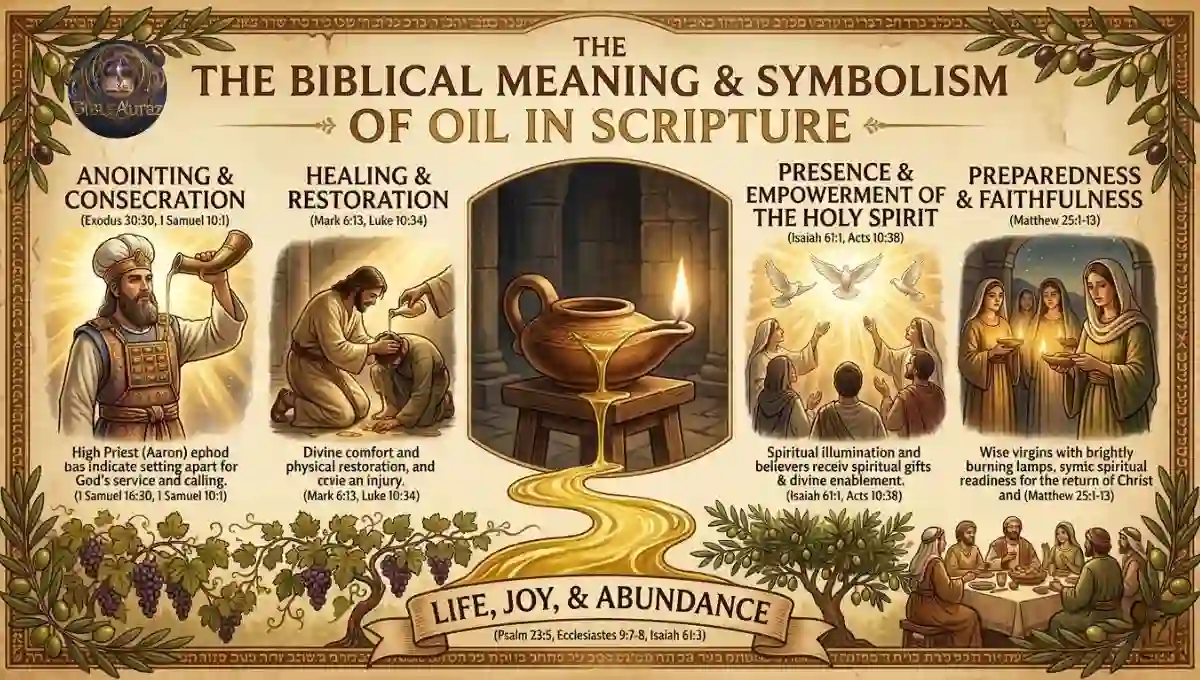
Oil appears over 200 times in the Bible making it one of the most richly symbolic substances in all of Scripture. It represents divine empowerment, the presence of the Holy Spirit, spiritual renewal, healing, consecration, and the light of God’s truth. Whether poured on a king, smeared on a priestly garment, or flowing from the olive trees of Zechariah’s vision, oil in the Bible is never merely physical; it always points to something deeper.
From Genesis to Revelation, the symbolism of oil threads through the entire biblical narrative. Jacob anointed a stone pillar at Bethel. Moses received a precise recipe for sacred anointing oil at Sinai. David was anointed king, and the Spirit of the Lord fell on him from that day forward. Jesus whose very title “Christ” means “the Anointed One” was anointed with the Holy Spirit and power. It is never incidental in Scripture. It is always intentional, always theological, always pointing toward God.
This guide unpacks the major biblical and spiritual meanings of oil drawing on key passages from the Old and New Testaments, including Psalm 23, Zechariah 4, James 5, and the teachings of Jesus so that every believer can understand this profound symbol and apply its truths to their faith journey today.
Oil in the Old Testament: Consecration, Authority, and the Spirit of God
The first act of anointing recorded in Scripture comes in Genesis 28:18, when Jacob poured oil on a pillar at Bethel after encountering God in a dream. This single act established a pattern that would run through the entire Old Testament: It marks the moment when heaven touches earth, when God lays claim to a person, a place, or a purpose.
In Exodus 30:22–33, God gave Moses a detailed recipe for sacred anointing oil, a blend of myrrh, cinnamon, fragrant cane, cassia, and olive oil. This formula was so holy that reproducing it for personal use carried the punishment of being cut off from the community. The message was unmistakable: this oil belonged to God. It was not perfume. It was the mark of divine ownership.
“Take the finest spices… and make these into a sacred anointing oil, a fragrant blend, the work of a perfumer. It will be the sacred anointing oil.“
— Exodus 30:23–25 (NIV)
This sacred oil was used to consecrate the Tabernacle, the Ark of the Covenant, the altar, and the priests. Every time it was applied, the message was the same: this is set apart for God. Nothing anointed with this oil could be treated as ordinary. Anointing was the visible sign of an invisible reality that God had chosen, claimed, and commissioned whatever the oil touched.
Anointing Oil in the Bible: A Reference Table
| Scripture | Who / What Was Anointed | Spiritual Meaning |
| Genesis 28:18 | Stone pillar at Bethel (Jacob) | Consecrating a place where God appeared |
| Exodus 30:22–28 | Tabernacle & its furnishings | Setting apart sacred space for God’s presence |
| Leviticus 8:30 | Aaron and his sons (priests) | Consecration for holy service and intercession |
| 1 Samuel 16:13 | David (future king) | Holy Spirit falls; divine calling confirmed |
| 1 Kings 19:16 | Elisha (prophet) | Prophetic calling and divine commissioning |
| Psalm 23:5 | The psalmist (believer) | God’s blessing, restoration, and favor |
| Isaiah 61:1 | The coming Messiah | Spirit-empowered ministry of liberation |
| James 5:14–15 | The sick (early Church) | Healing, faith, and the prayer of the community |
The Old Testament anointed three categories of people: prophets, priests, and kings. Every act of anointing signaled the same truth: God was not simply choosing a person, He was equipping them. The Hebrew word mashach (to anoint) is the root of Mashiach Messiah. The whole system of anointing in the Old Testament was a long, layered prophecy pointing to the one ultimate Anointed One who would come.
David’s Anointing and the Connection Between Oil and the Holy Spirit
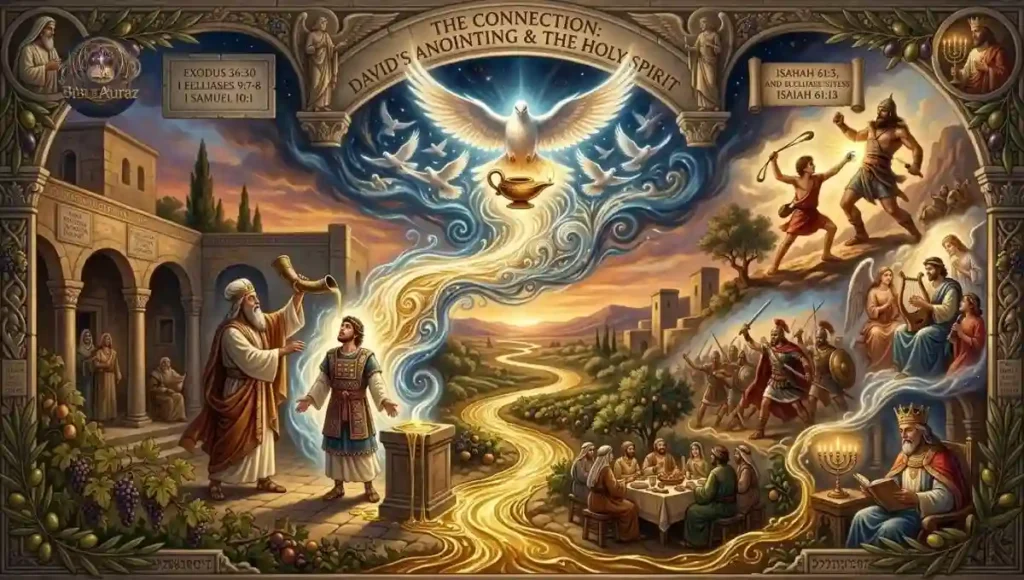
The most theologically loaded anointing in the Old Testament is found in 1 Samuel 16. Samuel arrives at Jesse’s house to anoint Israel’s next king. One by one, Jesse’s sons pass before the prophet and one by one, God rejects them. Then the youngest son, David, is called in from the fields. Samuel pours the oil on his head, and what happens next defines the entire biblical connection between oil and the Holy Spirit.
“So as David stood there among his brothers, Samuel took the flask of olive oil he had brought and anointed David with the oil. And the Spirit of the LORD came powerfully upon David from that day on.“
— 1 Samuel 16:13 (NLT)
The sequence is precise and purposeful: oil poured, Spirit falls. This is not a coincidence. The visible application of oil was a sign and a seal of what God was doing invisibly pouring out His Spirit on the one He had chosen. From this moment forward in Scripture, oil and the Holy Spirit are theologically intertwined. One is physical; the other is divine. But they point to the same reality: God at work in and through a human life.
This pattern repeated throughout Israel’s history. When prophets anointed priests, kings, or fellow prophets, the expectation was always the same: where the oil goes, the Spirit follows. The oil was never the source of power, it was the symbol of the Source. The oil said, “The Spirit of the living God is upon this person for this purpose.” That is why the strictness around the sacred anointing oil was so severe. It was not chemistry. It was a covenant.
Key Insight: The Hebrew term mashach (anoint) is the root of Mashiach Messiah. The Greek equivalent is Christos Christ. Every time Scripture calls Jesus “the Christ,” it is saying: He is the Anointed One, the one on whom the Spirit rests without measure.
The Shepherd Psalm
Psalm 23:5 “You Anoint My Head with Oil”
Psalm 23 is arguably the most beloved passage in all of Scripture. Most readers focus on green pastures and still waters but tucked into verse 5 is one of the most intimate images of God’s care in the entire Bible: “You anoint my head with Amish; my cup overflows.” In the context of the Psalm, this image draws on the ancient practice of a shepherd caring for his sheep.
In the ancient Near East, shepherds would anoint sheep with olive oil to protect them from insects that burrowed into the wool and skin during summer months. The oil also soothed wounds, repelled parasites, and was applied to the heads of honored guests at a feast as a mark of welcome and celebration. Both layers of meaning are alive in Psalm 23. God is the shepherd who tenderly protects and heals. God is also the host who honors His guest at the table even “in the presence of my enemies.”
“You prepare a table before me in the presence of my enemies. You anoint my head with oil; my cup overflows. Surely your goodness and love will follow me all the days of my life.”
— Psalm 23:5–6 (NIV)
The anointing in Psalm 23 is not about formal consecration or kingly authority; it is about tenderness, restoration, and overflowing grace. God does not merely tolerate His people. He anoints them. He sets a table for them. He fills their cup until it runs over. The oil in this verse is the language of extravagant love, of a God who does not do His care in half-measures. The overflowing cup says that God’s goodness cannot be contained; it spills out into every part of life.
Three Layers of Meaning in Psalm 23:5
- Protection:As shepherds oiled their sheep against insects and disease, God’s anointing shields believers from spiritual harm, anxiety, and the assaults of the enemy.
- Healing: It was a healing agent in the ancient world. God’s anointing restores what is wounded the broken heart, the grieving spirit, the weary soul.
- Honor:In ancient hospitality, anointing a guest with oil was the highest act of welcome. God treats every believer not as a servant but as an honored guest at His own table.
Prophetic Vision
Zechariah 4 The Olive Trees, the Lampstand, and God’s Spirit
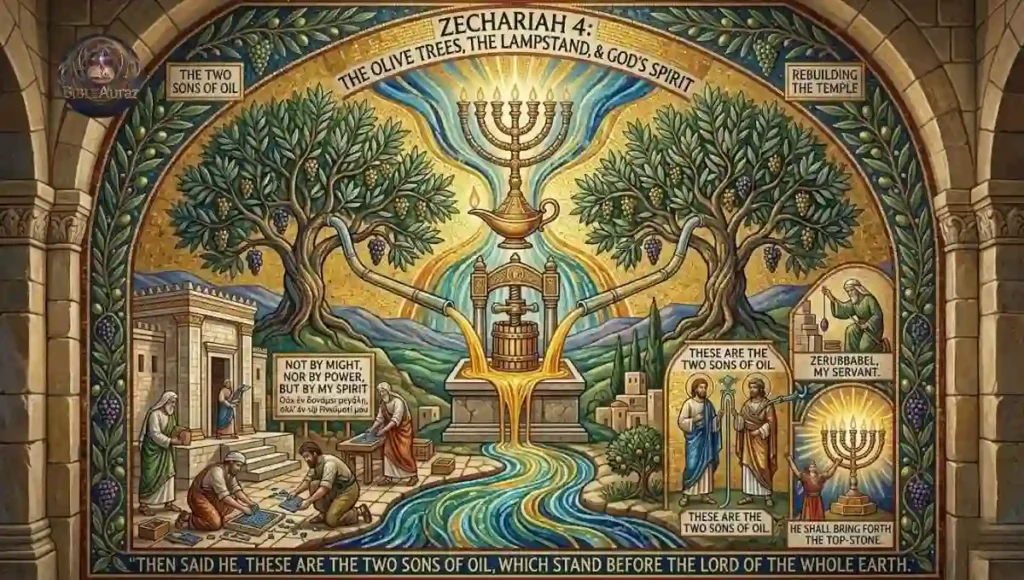
Zechariah 4 contains one of the most striking and theologically rich visions in all of prophetic Scripture. The prophet sees a golden lampstand with a bowl at its top and seven lamps fed not by human hands, but by two olive trees on either side that pour It directly into the lampstand through golden pipes. The lamps never go out because they never run dry. The supply is constant, spontaneous, and divine.
“This [continuous supply of oil] is the word of the LORD to Zerubbabel: ‘Not by might nor by power, but by My Spirit,’ says the LORD of hosts.“
— Zechariah 4:6 (AMP)
God himself interprets the vision: the oil is a symbol of His Spirit. The lampstand represents the people of God, called to be a light in the world. The olive trees represent the anointed leaders in Zechariah’s day, the governor Zerubbabel and the high priest Joshua who are themselves channels of the Spirit’s power. The entire image communicates one thundering truth: God’s work cannot be accomplished by human effort or institutional strength. It flows from His Spirit alone, continuously, without interruption, without depletion.
| Symbol in Zechariah 4 | Immediate Meaning | Spiritual / Prophetic Meaning |
| Golden Lampstand | The Temple menorah | God’s people called to shine light into the world |
| Seven Lamps | Completeness / the eyes of the Lord | God’s omnipresence and total awareness |
| Two Olive Trees | Zerubbabel & Joshua (governor & priest) | The offices of king and priest fulfilled ultimately in Christ |
| Golden Oil / Pipes | The supply of lamp fuel | The Holy Spirit: continuous, inexhaustible, supernatural |
| Self-filling Lamps | No human maintenance needed | God’s work sustained by His Spirit, not human effort |
The New Testament picks up this imagery directly. Revelation 11:4 identifies two witnesses as “the two olive trees and the two lampstands that stand before the Lord of the earth” pointing back to Zechariah’s vision and forward to its ultimate fulfillment. Jesus himself declared in John 15 that He is the vine and believers are the branches. The oil flows from the source. We do not generate it, we receive it and carry it.
“Not by Might, Nor by Power, But by My Spirit”
Zerubbabel faced a mountain of rubble where the Temple should have stood. The task was overwhelming. God’s answer was not a battle plan or a fundraising strategy. It was a vision of inexhaustible oil. The Spirit of God never runs low. Every task God assigns to His people comes with a supernatural supply of Spirit-power to accomplish it. The lamps burn as long as the trees stand and the trees stand before the Lord of all the earth.
Must Read: Gold in Dreams Biblical Meaning
Jesus: The Ultimate Anointed One and Oil in the New Testament
The New Testament does not abandon the symbolism of oil; it fulfills it. The Greek word Christos means “the Anointed One.” Every time the New Testament calls Jesus “Christ,” it is an implicit reference to anointing declaring that the Spirit of God rests on Him without measure, that He is the one toward whom every Old Testament anointing was pointing. Peter made this explicit in Acts 10:38: “God anointed Jesus of Nazareth with the Holy Spirit and with power. He went about doing good and healing all who were oppressed by the devil, for God was with him.”
When Jesus read from Isaiah 61 in the synagogue at Nazareth “The Spirit of the Lord is upon me, because he has anointed me to proclaim good news to the poor” and then declared, “Today this Scripture is fulfilled in your hearing,” He was identifying himself as the Anointed One. The oil of the prophets and priests and kings of the Old Testament was a long shadow cast backward from the cross, pointing to this moment.
“You have an anointing from the Holy One, and all of you know the truth.“
— 1 John 2:20 (NIV)
The extraordinary claim of the New Testament is that every believer now shares in this anointing. What was once reserved for prophets, priests, and kings, the oil poured from above is now poured on every person who belongs to Christ. As 2 Corinthians 1:21–22 says, “He anointed us, set his seal of ownership on us, and put his Spirit in our hearts as a deposit, guaranteeing what is to come.” The oil has become an inner reality, not an external ceremony.
The Parable of the Ten Virgins (Matthew 25:1–13)
Jesus told a parable about ten virgins waiting for a bridegroom. Five were wise and brought extra oil for their lamps. Five were foolish and brought none. When the bridegroom was delayed, their lamps burned low and the foolish five had nothing left. The wise five entered the wedding feast. The others were shut out. The oil in this parable is a vivid picture of spiritual readiness and the inner life of genuine faith. It cannot be borrowed at the last moment. It must be cultivated over a lifetime of closeness with God. The lamp is useless without the oil; life is useless without the Spirit.
Anointing the Sick: James 5:14–15
James 5 gives the New Testament church a clear instruction: when someone is sick, let the elders pray over them and anoint them with oil in the name of the Lord. This practice stands at the intersection of the symbolic and the practical. Oil had genuine medicinal properties in the ancient world. But the anointing in James is not primarily medical, it is theological. It is a declaration of dependence on God. It says: we are applying what is physical to ask for what is supernatural. We anoint in the name of the Lord because it is His power, not ours, that heals.
What Oil Symbolizes in the Life of a Believer Today
The symbolism of oil in Scripture is not locked away in ancient history. Every layer of meaning speaks directly to the Christian life in the present day. Understanding what oil represents gives believers a richer vocabulary for understanding the work of the Holy Spirit and the grace of God in their own experience.
- The Holy Spirit’s Presence:Just as oil was poured on those God chose, the Holy Spirit is poured into every believer at conversion. You are anointed. You are set apart. You carry the Spirit of the living God.
- Consecration and Purpose:Anointing in the Bible always meant being set apart for a specific calling. Every believer has a calling and the Spirit who anointed prophets and kings anoints you for yours.
- Healing and Restoration:Oil in Psalm 23 speaks of God’s tender care for wounds. The Holy Spirit is the Comforter the one who soothes, restores, and heals what is broken in the inner life.
- Illumination and Truth:Oil fueled the lamps of the Tabernacle. The Holy Spirit illuminates the Word of God making Scripture come alive, bringing understanding where there was darkness.
- Divine Empowerment:Zechariah 4 declares that God’s work is done “not by might nor by power, but by My Spirit.” The Christian life cannot be lived on human effort alone. It requires the continuous supply of the Spirit’s oil.
- Preparedness:The wise virgins of Matthew 25 kept their oil replenished. Spiritual preparedness through prayer, Scripture, worship, and fellowship keeps the believer’s lamp burning bright.
Frequently Asked Questions
What does oil symbolize in the Bible?
Oil in the Bible symbolizes the Holy Spirit, healing, blessing, and God’s presence. It is often used to show being chosen and set apart by God.
Is oil a direct symbol of the Holy Spirit in the Bible?
Yes, oil is commonly used as a symbol of the Holy Spirit, especially in anointing, representing empowerment, guidance, and divine presence.
What is the meaning of “anointing” in the Bible?
Anointing means being set apart or chosen by God for a special purpose, usually through oil as a physical symbol of spiritual consecration.
What does Zechariah 4 teach about oil and the Holy Spirit?
Zechariah 4 shows olive oil flowing continuously, symbolizing the Holy Spirit’s endless power and God’s work done not by human strength but by His Spirit.
Why did Jesus anoint the sick with oil in the New Testament?
Oil was used as a symbol of healing and faith, showing God’s power to restore physically and spiritually through prayer and divine authority.
What does “anointing my head with oil” mean in Psalm 23?
Psalms 23 means God’s blessing, protection, and honor, showing the believer is valued, refreshed, and cared for by the Lord.+
Conclusion
Oil is one of the most significant symbols in all of biblical revelation. It tells the story of a God who is not distant or indifferent but who pours Himself out on those He loves, anointing them, healing them, empowering them, and honoring them. From Jacob’s stone at Bethel to the lampstand of Zechariah’s vision, from David on a hillside in Bethlehem to the wise virgins keeping their lamps filled oil carries the same message across every century: the Spirit of God is the source of all true light, all true power, and all true life.
For the believer today, this rich biblical symbolism is not merely history, it is a living reality. You have been anointed. The Spirit of the living God rests on you. Your lamp has been lit from the fire of heaven. Keep it filled. Walk in the anointing. And like the lamps of Zechariah’s vision, let the oil flow freely through you not by your might, not by your power, but by His Spirit.

Welcome to BibleAuraz! I’m Abdul Mannan Haider — Christian Faith Writer | 10+ Years Bible Study Experience | Founder of (BibleAuraz.com) Sharing Bible verses, spiritual meanings, prayers, and biblical wisdom to strengthen your faith and inspire your daily walk with God.